Most people are aware that women are capable of having multiple orgasms, but far fewer seem to know that it’s possible for men to have them as well. The principle behind this is that ejaculation and orgasm are not the same thing. There is a difference between the pleasurable sensations of the orgasm and the physical event of ejaculation. In essence, you can have an orgasm without ejaculating, and you can ejaculate without having an orgasm.The trick is distinguishing between the two and learning to control both. To start with, you need to develop your sexual strength.
Strengthening the PC Muscle
The pubococcygeus is the hammock-like muscle hanging low in the perineum, the area between the scrotum and the anus. You can contract it by pretending to stop the flow of urine. To strengthen it, you have to work it out like any muscle. Here are three recommended exercises:
1) Quick squeeze: Squeeze your PC muscle as tightly as you can and hold it for 2 seconds, and then completely relax the muscle. That is one repetition. Rest 1 second between reps. Do 20-100 repetitions (add 10 reps per week).
2) Slow Squeeze: Squeeze your PC muscle as tightly as you can and hold it for 15 seconds, and then release slowly, completely relaxing the muscle. That is one repetition. Rest 5 seconds between reps. Do 10-25 repetitions (add 3 reps per week).
3) Long Squeeze: Squeeze your PC muscle as tightly as you can and hold it for a minimum of 60 seconds, and then release. That is one repetition. Rest 60 seconds between reps. Do 2-10 repetitions (add 1 rep per week).
Once the muscles are strengthened, you can learn to separate orgasm and ejaculation. What you have to do to achieve male multiple orgasm is to figure out exactly where your ejaculatory "point of no return" is, and what it feels like. Then when you get close to ejaculation, you hold back by slowing down or stopping by pulling out of the vagina. By squeezing the PC muscle before the "point of not return," you may experience “mini-orgasms” that feel very pleasurable and enable you to continue having sex for an extended period of time.
Additional Techniques for Ejaculatory Control
1) Pressing the Million Dollar Point. This point is located on your perineum just in front of the anus. You will feel a slight indentation when you push at the right spot. When you approach ejaculation, take your finger and push it up into the Million Dollar Point all the way to the first joint of your finger. This will help delay ejaculation by interrupting the ejaculatory reflex. This technique is great because you can use it without having to withdraw your penis from the vagina.
2) Scrotal Tugging. As the name implies, either you or your partner simply pulls your testicles away from your body to delay ejaculation. This is accomplished by circling the top of your scrotal sac with your thumb and forefinger and pulling down firmly.
3) The Squeeze Technique. When you feel yourself getting close to orgasm, withdraw your penis from the vagina. Then place the first two fingers of either hand on the underside of the penis, place your thumb on the top, and then squeeze. You can do this yourself, or you can have your partner squeeze the head of the penis between her thumb and fingers. Since your penis is erect, it won’t really hurt if she gives it an intense squeeze.
You should practice these ejaculatory control techniques at least 3 to 5 times a week. Applying any or all of these techniques teaches your body to gain control over what is wrongly perceived as one of the most uncontrollable of impulses.
In addition to the PC muscle exercises and the additional techniques for controlling ejaculation, you also want to focus on breathing. Since the breath is the gateway to controlling your entire body, you need to practice strengthening and deepening your breathing patterns. Inhale through your nose and feel your lower abdomen expand at the navel area. While keeping your chest relaxed, exhale with some force to pull the lower abdomen back, as if you were pulling your navel back towards your spine. Notice also that your penis and testicles pull up while exhaling. Continue breathing this way between 20 to 35 times. Learning to control your breathing in this way will become essential to stopping yourself from ejaculating and to expanding the feeling of orgasm throughout your entire body.
Exercise to Separate Orgasm from Ejaculation
Lubricate your penis. Begin pleasuring yourself - not just your penis, but your scrotum and perineum. Become aware of your rate of arousal. Notice the tingling at the base of your penis, the stages of erection, and the changes in both your breathing and your heartbeat.
Stimulate yourself almost to the point of orgasm, and then stop. Breathe deeply and contract your PC muscle. You can also delay ejaculation by pressing on the Million Dollar Point, using the Scrotal Tug, or by squeezing the tip of your penis. (You will have to discover which of these techniques works best for you and keep practicing it.) Very important: pay close attention to your arousal and stopping in time - at least a few strokes before the “point of no return."
If you’re finding it difficult to keep from ejaculating, keep squeezing and releasing your PC muscle several times. Stop for a few seconds and practice your deep breathing.
After you have peaked several times without ejaculating, stop. You should feel relaxed and energized. Take note of the sexual energy circulating in your body, which you will feel as a tingling or prickling.
It will take practice and dedication on your part to achieve male multiple orgasm. It probably won’t happen in a single sitting. Most men who practice the above exercises will begin to experience multiple orgasms within a week or two and will master them within three to six months. The more you gain control over your body, the easier it will become to climax again and again during a single session of lovemaking.
If you are not happy with the size of your penis, I highly recommend you check out PenisAdvantage. PenisAdvantage provides unique natural penis enlargement exercises that you can try at home to enlarge your penis by 1 to 4 inches naturally without the need for any medication or drugs.
Showing posts with label articles. Show all posts
Showing posts with label articles. Show all posts
Wednesday, July 2, 2008

Thursday, April 10, 2008
Two Tantric Techniques for Ejaculatory Control
 According to studies, around 70 percent of women do not reach an orgasm during intercourse. Why? One reason may be that the man does not know how to properly stimulate her, so she never really becomes aroused enough to climax. Another reason is that he ejaculates before she has time to to reach climax.
Two Tantric techniques for ejaculatory control will allow you to last long enough for her to climax. Use masturbation to practice these exercises before trying them with your partner. It will take most men several sessions to master each one. Even the most sympathetic wife or girlfriend will get tired of being used for "training."
Exercise One: Pressing the Prostate Point (PPP)
Between your testicles and anus is the perineum. There 's a soft spot there through which you can apply pressure to your prostate. For most men, prostate stimulation reduces the likelihood of ejaculating involuntarily. This is because it flushes seminal fluid from the prostate gland .
If you push hard enough on your prostate point right before ejaculating, it actually blocks the emission phase (ejaculation phase). This exercise prevents seminal fluid from entering the urethral canal when your orgasmic spasms start. Even if you have orgasmic contractions, the semen remains inside your body and is re-absorbed.
1) Pleasure yourself till you begin to feel the tension that tells you you're on your way to ejaculating.
2) Stop all motion, locate your prostate point, and press upward firmly for 10 to 30 seconds. You should feel the sexual tension you were just feeling begin to subside.
3) Now pleasure yourself again. This time, go a bit past the tension you felt in Step 1.
4) Stop all motion, locate your prostate point, and press upward firmly for 10 to 30 seconds. You should feel the sexual tension you were just feeing begin to subside.
5) Now pleasure yourself again. This time, go a bit past the tension you felt in Step 3.
6) Locate your prostate point, and press upward firmly for 10 to 30 seconds. However, this time, try to continue stroking yourself as you do this.
7) Continue doing this exercise till you master reaching higher sexual peaks and bringing yourself down again.
Exercise Two: Root Lock
Inside your body, at the base of your penis is the muscle called pubococcygeus. People call it PC for short. This exercise teaches you to use your PC muscles to delay ejaculation. To perform a Root Lock, hold your breath momentarily and push your pelvic muscles out like straining to empty your bowels. Some men prefer pushing in rather than out.
1) Pleasure yourself till you begin to feel the tension that tells you you're on your way to ejaculating.
2) Exhale all your breath and hold it, keep your eyes wide open looking upward, push your tongue on the roof of your mouth, tighten your fingers, hands, and feet, and push out on your anus until your arousal subsides.
3) Now pleasure yourself again. This time, go a bit pass the tension you felt in Step 1.
4) Exhale all your breath and hold it, keep your eyes wide open looking upward, push your tongue on the roof of your mouth, tighten your fingers, hands, and feet, and push out on your anus until your arousal subsides.
5) Now pleasure yourself again. This time, go a bit pass the tension you felt in Step 3.
6) Exhale all your breath and hold it, keep your eyes wide open looking upward, push your tongue on the roof of your mouth, tighten your fingers, hands, and feet, and push out on your anus until your arousal subsides. This time, though, contract your anal muscles inward and upward while pulling your stomach toward your spine. Which works better for you, in or out?
7) Continue doing this exercise until you master reaching higher sexual peaks and bringing yourself down again.
Once you've mastered a technique during masturbation, try it with your partner. Though it will be tougher to maintain control with a soft, warm body pressed against you, the procedure is identical. If you don't succeed at first, go back to practicing with masturbation, and then try again. The goals of controlling your ejaculation and satisfying your partner are worth whatever time and effort it takes.
If you are not happy with the size of your penis, I highly recommend you check out PenisAdvantage. PenisAdvantage provides unique natural penis enlargement exercises that you can try at home to enlarge your penis by 1 to 4 inches naturally without the need for any medication or drugs.
Tuesday, March 11, 2008
12 Steps to Better Sleep
From having occasional difficulty sleeping to insomnia, there is a lot you can do to get a better night's sleep, feel refreshed when you awake, and remain alert throughout the day. We all have trouble sleeping from time to time, but you can sleep better every night by following these 12 simple steps.
1) Maintain a regular sleep schedule. Get up at the same time each morning, regardless of the previous night’s sleep, to help set your biological clock.
2) To consolidate and deepen sleep, restrict the amount of sleep to only as much as needed to feel refreshed during the following day - usually 7-8 hours.
3) Arrange the bedroom so that it is a comfortable setting. Insulate it against sound and light by using carpets and curtains. Ear plugs and eye masks may be helpful.
4) Keep the room at a cool to moderate temperature. Excessive heat disturbs sleep.
5) Use the bedroom for sleeping and sexual activity only.
6) Turn off your phone.
7) Avoid liquids before going to sleep to minimize nighttime trips to the bathroom. If liquids are not a problem, try drinking warm milk at bedtime.
8) Avoid alcohol, tobacco, and caffeinated beverages, especially in the evening. Although alcohol may help you fall asleep, it causes subsequent sleep to be fragmented.
9) Avoid napping longer than one hour or after 4 pm.
10) Exercising regularly helps deepen sleep, but strenuous exercise should be completed no later than three hours before going to bed.
11) Try a relaxation techniques, such as, biofeedback, meditation, yoga, progressive muscle relaxation, or massage to prepare the mind and body for sleep.
12) As far as possible, work out family or job-related problems before going to sleep.
It is becoming increasing clear how critical sound sleep is to your health and well-being, Many sleep problems go unrecognized for years, leading to unnecessary suffering, poor quality of life, accidents, and great expense. Following the 12 steps to better sleep can have a tremendous impact upon your overall health and quality of life.
To get FREE access to the exclusive series "What Are the 7 Biggest Mistakes Most Insomniacs Make?" click here. To read my review of the two best resources for better sleep you can choose, go to my blog Better Sleep.
1) Maintain a regular sleep schedule. Get up at the same time each morning, regardless of the previous night’s sleep, to help set your biological clock.
2) To consolidate and deepen sleep, restrict the amount of sleep to only as much as needed to feel refreshed during the following day - usually 7-8 hours.
3) Arrange the bedroom so that it is a comfortable setting. Insulate it against sound and light by using carpets and curtains. Ear plugs and eye masks may be helpful.
4) Keep the room at a cool to moderate temperature. Excessive heat disturbs sleep.
5) Use the bedroom for sleeping and sexual activity only.
6) Turn off your phone.
7) Avoid liquids before going to sleep to minimize nighttime trips to the bathroom. If liquids are not a problem, try drinking warm milk at bedtime.
8) Avoid alcohol, tobacco, and caffeinated beverages, especially in the evening. Although alcohol may help you fall asleep, it causes subsequent sleep to be fragmented.
9) Avoid napping longer than one hour or after 4 pm.
10) Exercising regularly helps deepen sleep, but strenuous exercise should be completed no later than three hours before going to bed.
11) Try a relaxation techniques, such as, biofeedback, meditation, yoga, progressive muscle relaxation, or massage to prepare the mind and body for sleep.
12) As far as possible, work out family or job-related problems before going to sleep.
It is becoming increasing clear how critical sound sleep is to your health and well-being, Many sleep problems go unrecognized for years, leading to unnecessary suffering, poor quality of life, accidents, and great expense. Following the 12 steps to better sleep can have a tremendous impact upon your overall health and quality of life.
To get FREE access to the exclusive series "What Are the 7 Biggest Mistakes Most Insomniacs Make?" click here. To read my review of the two best resources for better sleep you can choose, go to my blog Better Sleep.
Friday, February 8, 2008
A Natural Aid to Better Erections
Can a man aid his erection without expensive and potentially dangerous medications, such as Viagra, Cialis, or Levitra? The answer is yes. There has been such a natural way to increase the quality and quantity of erections in the Mediterranean area since before recorded history.
The pistachio is full of micronutrients, many of which are responsible for the male sexual response. When mixed with honey, the nutritional value of pistachios produces a highly enriched food that will show its benefit to overall good health and circulatory benefits demonstrated by rock-hard erections. The pistachio - honey elixir recipe below produces enhanced erections and an abundance of semen.
Add about one cup full of dry roasted pistachios to an equal amount of natural organic honey. Place the mixture into a glass jar, and expose to the sun for one week. After one week's exposure, the mixture is ready.
Take one tablespoon of the pistachio - honey elixir every morning and one tablespoon when sexual activity is anticipated. It also may be eaten alone, mixed with natural, unflavored yogurt, or poured onto fruit. Over time, the result will be rock-hard erections and a healthy sex drive.
If you are not happy with the size of your penis, I highly recommend you check out PenisAdvantage. PenisAdvantage provides unique natural penis enlargement exercises that you can try at home to enlarge your penis by 1 to 4 inches naturally without the need for any medication or drugs.
The pistachio is full of micronutrients, many of which are responsible for the male sexual response. When mixed with honey, the nutritional value of pistachios produces a highly enriched food that will show its benefit to overall good health and circulatory benefits demonstrated by rock-hard erections. The pistachio - honey elixir recipe below produces enhanced erections and an abundance of semen.
Add about one cup full of dry roasted pistachios to an equal amount of natural organic honey. Place the mixture into a glass jar, and expose to the sun for one week. After one week's exposure, the mixture is ready.
Take one tablespoon of the pistachio - honey elixir every morning and one tablespoon when sexual activity is anticipated. It also may be eaten alone, mixed with natural, unflavored yogurt, or poured onto fruit. Over time, the result will be rock-hard erections and a healthy sex drive.
If you are not happy with the size of your penis, I highly recommend you check out PenisAdvantage. PenisAdvantage provides unique natural penis enlargement exercises that you can try at home to enlarge your penis by 1 to 4 inches naturally without the need for any medication or drugs.
Wednesday, February 6, 2008
Breathing to Fall Asleep Easily
 Insomnia is a sleep disorder in which a person experiences poor sleep or has trouble sleeping. Poor sleep for any length of time can lead to mood disturbances, lack of motivation, decreased attention span, trouble with concentration, low levels of energy, and increased fatigue. If you're troubled by difficulty falling asleep, practice this breathing exercise when you go to bed at night. It's simple, but highly effective.
Lie down and relax your body as best as you can. Take a few slow, deep breaths. Each time you breathe in imagine the air gently flowing into your lungs and stomach. Then visualize the air flowing out smoothly and easily as you exhale.
With each outgoing breath, imagine that you are relaxing your body more and more, that that you're going deeper within yourself. See and feel all your stresses and tensions easily dissolving and going away with each outgoing breath. Do this five times.
Next, breathe in slowly to the count of four. Once your lungs are comfortably full, hold your breath for one second. Breathe out slowly to the count of eight. Feel yourself relaxing more deeply each time you breathe out.
Repeat this process ten times. At the end of it, you'll find yourself in a deep state of relaxation physically and mentally. You will notice the effects immediately. You will feel much calmer and any constriction in your chest and head will likely have dissolved.
Make this breathing exercise a part of your bedtime routine. You will soon associate this exercise with falling asleep, and you will indeed fall asleep more easily.
To get FREE access to the exclusive series "What Are the 7 Biggest Mistakes Most Insomniacs Make?" click here. To read my review of the two best resources for better sleep you can choose, go to my blog Better Sleep.
Thursday, October 4, 2007
Double Your Pull-ups in Six Weeks or Less
The pull-up is the king of upper body exercises. Being able to pull up one's own body weight is one of the most useful tests of functional strength. Elite military units, such as Navy SEALs and Air Force Special Tactics, want their members to be able to do at least 20 pull-ups. As a freshman in high school, I watched a classmate (a heavily muscled swimmer) do 47 during lunch recess. However, the overwhelming majority of men and women (Yes, women can do pull-ups.) can't even do 10. If you would like to dramatically improve your upper body strength, here is the program I used to double my pull-up totals in only five weeks.
Major Charles Lewis Armstrong, USMC, used this routine to prepare himself for an attempt to set a world record for pull-ups. The Armstrong pull-up program consists of two workouts per day, five days a week. Before you faint at the thought of violating the "laws" of fitness that restrict exercise to 3 days a week every other day, remember that the amount of recovery time needed from exercise varies with the type, volume, and intensity. The military typically uses a Monday through Friday training schedule for calisthenics.
Monday: Do five maximum effort sets. Rest 90 seconds between each set. Make sure that each set is a maximum effort set, but don't concern yourself with numbers. You will probably increase the numbers in the last two sets before you see much improvement in the first three.
Tuesday: Pyramid Day. Start the pyramid with one repetition, the next set has two repetitions, the next has three. Rest 10 seconds for each repetition in the previous set. Continue adding reps to each set until you miss a set. That means, if your last set was five, and your next set should be six, but you could only do four, you missed a set. Then finish your workout with one more set at a maximum effort.
Wednesday: Do three “training sets” of overhand pull-ups, three sets of underhand pull-ups, and three sets of overhand pull-ups where the back of your neck touches the bar. Rest 60 seconds between sets. A training set is determined by your current level of strength. If you are advanced, it might be 5 or 6. The goal of the workout is to do the same number of repetitions per set, so start off conservatively. If you can only do one, use one. You must complete nine training sets for this workout.
Thursday: Do the maximum number of training sets that you can. Use the same number of repetitions that you used in your Wednesday sets. Rest 60 seconds between each set. Do training sets until you miss a set.
Friday: Repeat the day that you found to be the hardest in the previous four days. This may vary from week to week.
Most people who stick with this program are able to double their pull-ups in 4-6 weeks. In addition to pull-ups, Major Armstrong did three maximum effort sets of push-ups every morning, and then did his pull-up routine 3-4 hours later. That workout schedule is probably not convenient for most people, but it doesn't have to be followed exactly. Just be sure to do the pull-up routine separately from the push-ups. Though I don't recommend it, you could also skip the push-ups unless you're training for a fitness test which includes push-ups.
Unless you are facing a make-or-break fitness test, I personally wouldn't follow this program longer than 6-8 weeks even if you haven't reached your ultimate goal number. Change to a different exercise routine, while maintaining your pull-up gains by doing 5 sets of 50% of your max, five days a week, or doing your max reps at least twice a week. In other words, if you want to maintain the ability to do 20 pull-ups, do 5 sets of 10, five days a week, or do a set of 20 at least twice a week. After 1-2 months, you should be able to go back to the Armstrong pull-up program at about the same place you left off and push on to the next level.
For a free mini course on how to simultaneously improve strength and conditioning while burning fat, click here. Read my review of the two best bodyweight exercise courses you can choose.
Major Charles Lewis Armstrong, USMC, used this routine to prepare himself for an attempt to set a world record for pull-ups. The Armstrong pull-up program consists of two workouts per day, five days a week. Before you faint at the thought of violating the "laws" of fitness that restrict exercise to 3 days a week every other day, remember that the amount of recovery time needed from exercise varies with the type, volume, and intensity. The military typically uses a Monday through Friday training schedule for calisthenics.
Monday: Do five maximum effort sets. Rest 90 seconds between each set. Make sure that each set is a maximum effort set, but don't concern yourself with numbers. You will probably increase the numbers in the last two sets before you see much improvement in the first three.
Tuesday: Pyramid Day. Start the pyramid with one repetition, the next set has two repetitions, the next has three. Rest 10 seconds for each repetition in the previous set. Continue adding reps to each set until you miss a set. That means, if your last set was five, and your next set should be six, but you could only do four, you missed a set. Then finish your workout with one more set at a maximum effort.
Wednesday: Do three “training sets” of overhand pull-ups, three sets of underhand pull-ups, and three sets of overhand pull-ups where the back of your neck touches the bar. Rest 60 seconds between sets. A training set is determined by your current level of strength. If you are advanced, it might be 5 or 6. The goal of the workout is to do the same number of repetitions per set, so start off conservatively. If you can only do one, use one. You must complete nine training sets for this workout.
Thursday: Do the maximum number of training sets that you can. Use the same number of repetitions that you used in your Wednesday sets. Rest 60 seconds between each set. Do training sets until you miss a set.
Friday: Repeat the day that you found to be the hardest in the previous four days. This may vary from week to week.
Most people who stick with this program are able to double their pull-ups in 4-6 weeks. In addition to pull-ups, Major Armstrong did three maximum effort sets of push-ups every morning, and then did his pull-up routine 3-4 hours later. That workout schedule is probably not convenient for most people, but it doesn't have to be followed exactly. Just be sure to do the pull-up routine separately from the push-ups. Though I don't recommend it, you could also skip the push-ups unless you're training for a fitness test which includes push-ups.
Unless you are facing a make-or-break fitness test, I personally wouldn't follow this program longer than 6-8 weeks even if you haven't reached your ultimate goal number. Change to a different exercise routine, while maintaining your pull-up gains by doing 5 sets of 50% of your max, five days a week, or doing your max reps at least twice a week. In other words, if you want to maintain the ability to do 20 pull-ups, do 5 sets of 10, five days a week, or do a set of 20 at least twice a week. After 1-2 months, you should be able to go back to the Armstrong pull-up program at about the same place you left off and push on to the next level.
For a free mini course on how to simultaneously improve strength and conditioning while burning fat, click here. Read my review of the two best bodyweight exercise courses you can choose.
Tuesday, September 4, 2007
The Ultimate Burpee Ladder Workout
If you think you're in pretty good physical condition, then try this workout, which I call the "Ultimate Burpee Ladder." This workout will separate the contenders from the pretenders, and leave the pretenders puking their guts out.
The Ultimate Burpee Ladder consists of one classic exercise, the "burpee." This exercise works your chest, arms, front deltoids, thighs and abs. The burpee is a six-count exercise:
1) Stand with your feet shoulder width apart and your hands raised over your head. Then squat down and place your palms on the floor by your feet.
2) Kick both of your legs back so that you're in push-up position.
3) Bend your elbows and lower your body until your chest touches the floor.
4) Push yourself back up.
5) At the end of the push-up, quickly pull both knees into your chest while keeping your hands on the floor. You're jumping back into the squat position of step one.
6) Stand straight up by straightening your legs and throwing your hands in the air over your head. You're now in the position that you started in. You can make the burpee more advanced and increase the explosive power in your legs by jumping into the air as you stand up.
To do the Ultimate Burpee Ladder workout, go to a football or soccer field, a track, or some other place where there is a clear area at least a 100 meters long. If you thought the Ultimate Burpee Ladder workout was only going to be burpees, you were so, so wrong. In between sets of burpees, you will be doing 100 yard sprints.
Take 5-10 minutes to do a light warm-up. If you're going to be doing the workout on a football or soccer field, position yourself at the goal line. Sprint the length of the field to the other goal line and then immediately do 10 burpees. Then sprint back to where you started and do 12 burpees. Continue sprinting and increasing the number of burpees in each set by two until you reach 24. By the way, notice that I did not say jog or even run; I said sprint. Sprint means "to race or move at full speed." The workout ends when you can't complete a set of burpees without stopping to rest, or you can't sprint.
The Ultimate Burpee Ladder workout consists of 136 burpees and eight 100 yard sprints--not huge numbers. It's doing each set and sprint one after the other with no rest that makes this the Ultimate Burpee Ladder.
If you couldn't complete the workout on your first try, join the club. To improve, you need to do the workout once a week. If that's too scary to contemplate, try this modification to lessen the pain a little while you improve your conditioning. Do your sets of burpees and your sprints separately--even on separate days if you need to at first. Allow 15 seconds of rest between sets of burpees, and 30 seconds of rest between 100 yard sprints. The same rules apply: when you have to stop in the middle of a set of burpees, or you can't maintain a sprint, the workout is over.
Many of you will be afraid to even try this workout. Others will be afraid to try it a second time. But for those of you who believe that "pain is just weakness leaving the body," completing the Ultimate Burpee Ladder workout will be a challenge that you just can't walk away from. Oo-Rah!
For a free mini course on how to simultaneously improve strength and conditioning while burning fat, click here. Read my review of the two best bodyweight exercise courses you can choose.
The Ultimate Burpee Ladder consists of one classic exercise, the "burpee." This exercise works your chest, arms, front deltoids, thighs and abs. The burpee is a six-count exercise:
1) Stand with your feet shoulder width apart and your hands raised over your head. Then squat down and place your palms on the floor by your feet.
2) Kick both of your legs back so that you're in push-up position.
3) Bend your elbows and lower your body until your chest touches the floor.
4) Push yourself back up.
5) At the end of the push-up, quickly pull both knees into your chest while keeping your hands on the floor. You're jumping back into the squat position of step one.
6) Stand straight up by straightening your legs and throwing your hands in the air over your head. You're now in the position that you started in. You can make the burpee more advanced and increase the explosive power in your legs by jumping into the air as you stand up.
To do the Ultimate Burpee Ladder workout, go to a football or soccer field, a track, or some other place where there is a clear area at least a 100 meters long. If you thought the Ultimate Burpee Ladder workout was only going to be burpees, you were so, so wrong. In between sets of burpees, you will be doing 100 yard sprints.
Take 5-10 minutes to do a light warm-up. If you're going to be doing the workout on a football or soccer field, position yourself at the goal line. Sprint the length of the field to the other goal line and then immediately do 10 burpees. Then sprint back to where you started and do 12 burpees. Continue sprinting and increasing the number of burpees in each set by two until you reach 24. By the way, notice that I did not say jog or even run; I said sprint. Sprint means "to race or move at full speed." The workout ends when you can't complete a set of burpees without stopping to rest, or you can't sprint.
The Ultimate Burpee Ladder workout consists of 136 burpees and eight 100 yard sprints--not huge numbers. It's doing each set and sprint one after the other with no rest that makes this the Ultimate Burpee Ladder.
If you couldn't complete the workout on your first try, join the club. To improve, you need to do the workout once a week. If that's too scary to contemplate, try this modification to lessen the pain a little while you improve your conditioning. Do your sets of burpees and your sprints separately--even on separate days if you need to at first. Allow 15 seconds of rest between sets of burpees, and 30 seconds of rest between 100 yard sprints. The same rules apply: when you have to stop in the middle of a set of burpees, or you can't maintain a sprint, the workout is over.
Many of you will be afraid to even try this workout. Others will be afraid to try it a second time. But for those of you who believe that "pain is just weakness leaving the body," completing the Ultimate Burpee Ladder workout will be a challenge that you just can't walk away from. Oo-Rah!
For a free mini course on how to simultaneously improve strength and conditioning while burning fat, click here. Read my review of the two best bodyweight exercise courses you can choose.
Friday, May 25, 2007
Don't Just Run: Sprint!
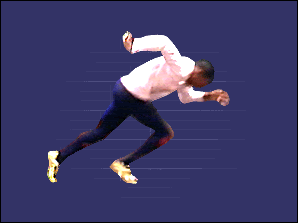 If you've been doing long, slow cardio, such as jogging, cycling, or swimming, for awhile without losing much weight or becoming much leaner even though you keep increasing your workouts, there is a simple explanation: too much cardio actually makes you fat. Excessive cardio increases stress hormones and down regulates the hormones, such as growth hormone and testosterone, that preserve muscle. In additon, elevated stress hormones make you insulin resistant, which leads to overeating as well as to eating foods that contribute to insulin resistance, such as sugars and starches.
Despite their appearance, many joggers and cyclists are not really lean. They may be slender because they have little muscle mass, but their body fat percentages are often surprisingly high.. In contrast, sprinters are lean and muscular with low body fat percentages. They have high human growth hormone (HGH) and testosterone levels--good for both females and males. Think back to the last track meet you saw. Who would you rather look like: the sprinters or the distance runners?
Benefits of Sprinting
1) Sprinting will reduce body fat and strengthen you far more than long, slow cardio because sprinting requires maximal recruitment of muscle. After about 8 seconds, sprinting sends acid signals to the muscles, which activates the fast twitch fibers. Fast-twitch fibers are thicker than slow twitch fibers, and it is fast twitch fibers that grow in size when activated by the right training.
2) Sprinting naturally increases human growth hormone. Human growth hormone increases muscle mass, thickens and adds flexibility to the skin, enhances the immune system, promotes weight loss through fat redistribution and loss, and increases stamina.
3) Sprinting strengthens your cardiovascular system with brief bursts of high intensity followed by long periods of recovery. You strengthen your skeletal muscles by doing heavy, low-repetition sets with long recoveries. You should strengthen your heart the same way. Sprinting doesn't cause the continuous stress on the heart that long, slow cardio does.
4) Sprint workouts are short and a lot more fun than long, boring cardio workouts.
The Definition of Sprinting
Based on the misleading articles and workouts I've seen posted all over the web, I'd better define what sprinting is. Sprinting is not just running faster than a jog. You cannot "sprint" for 30-60 second or even more with an equal recovery for 6-10 repetitions as some fitness "experts" advise. This is an anaerobic or interval workout. It's far better for you than plodding along the road or on a treadmill, but it's not sprinting and won't give you the benefits mentioned above. Sprint means "to race or move at full speed." Think playing tag or running to first base after a hit. Sprint workouts feature short, high-intensity repetitions and long, easy recoveries.
Where to Do a Sprint Workout
A track is the best place to do sprints because it's marked (in meters), and its surface is ideal for sprinting. A grass or dirt surface is next best; however, check your course for gopher holes and such before starting your sprints. Twisting an ankle will end your sprint workouts for awhile. The one place not to do your sprint workout is on concrete. Your back will thank you.
How to Do a Sprint Workout
Start your workout by warming up for about 5 minutes. Measure out a course from 50-100 yards (or meters) long. Remember that you need to sprint at least 8 seconds before your body sends the signals that produce human growth homone. Do 5-10 repetitions. The total distance of your sprints should not exceed 400-800 yards or meters. Between repetitions, walk slowly at least twice the distance that you ran. This should take from 1-2 minutes. Don't jog to "keep your heart rate up." You need to recover so that each repetition can be run at close to full speed. No matter what workout you planned, if you reach a point where you can't sprint because of fatigue, quit. Jogging to "finish" the workout won't do you any good since intensity is the objective, not volume.
If you're out of your teens and haven't been sprinting for a year or more, you will probably not be able to sprint at full speed right away. You should allow yourself at least a week for every decade you've lived to build up to full speed sprinting. In other words, if you're 40 and haven't been doing any sprinting in the past year, allow at least 4 weeks of gradually increasing the speed of your sprints before trying to go full speed in your workout. Even then, it doesn't hurt to hold back a little on the first repetition or two of each session.
How Often to Do a Sprint Workout
If you're running, cycling, swimming, etc. in addition to sprinting, limit your sprint workouts to twice a week with at least 48-72 hours between. If you're not doing anything else but strength training, you can go to 3 times a week if you want.
Sprinting is a natural and valuable human activity. If you think back to when you were a kid, how many times did you jog for miles? Almost never, right? On the other hand, you probably sprinted nearly every day on the playground, the athletic field, or just down the street. If you want to maintain a youthful body, you have to continue to do the things that youthful bodies naturally do. Sprinting is one of those things.
There is a common misconception that people are born with speed, but speed is like intelligence; it is invisible until developed. An amazing new book called Developing Killer Speed reveals how you can decrease your forty yard dash By .4 seconds in 2 weeks! To discover the simple formula that can increase your speed and decrease your times, click here.
Tuesday, April 24, 2007
Cardio or Strength Training First?
Many people need to do their cardio and strength training in the same exercise session because of their schedule or need to use fitness center facilities and/or equipment. Even experienced exercisers sometimes ask the question: should I do cardio or strength training first? Unfortunately, no one answer applies to everybody. It all depends on what your goals are. Once you've set your goals, though, it's easy to decide which to do first.
If you're a runner, swimmer, or cyclist (or all three) and strength training is intended to improve your sports performance and prevent injuries, do your cardio before your strength training. If you do strength training first, you will deplete the tremendous amount of energy you need to do hard endurance training. Training for endurance sports is so taxing, in fact, that many athletes don't feel like doing strength training afterwards. Don't go to that extreme, but you do have to be realistic. Your weights and reps are going to be less than what they would be if you hadn't done cardio exercise first. As long as you're putting forth your best effort and making progress, just relax and accept it.
If you're a strength athlete, such as a weightlifter, football player, or thrower, and cardio is intended to give you more endurance for your lifting or throwing and control your weight, do your cardio after your strength training. Your goal is to lift the most weight, the most times that you can, so you need to save the cardio for after your strength training. Doing cardio before will sap your strength.
If you're preparing for a military or law enforcement physical fitness, you need to find out the order of events in the test. Are the strength exercises done before the run and/or swim, or after? Whichever it is, do your workout in exactly the same order as the test is given. If for some reason you can't find out the order of the test, do your cardio after strength training. That's the typical order.
What if you're training for all-around fitness? In that case, alternate doing cardio before strength training and doing cardio after strength training. That will ensure equal development of both cardiovascular fitness and strength; plus, it's more realistic. Primitive humans, who were always in excellent physical conition, usually walked and jogged to the hunt or battle. Then they sprinted and did strength work (spear throwing, fighting, wrestling, etc.). However, often they would have to chase game or enemies (or run from them) afterwards too. On the other hand, sometimes they were surprised by an animal or ambushed by enemies and had to do their strength work first to defend themselves, and then do some cardio afterwards to get away. To be fit the way humans were meant to be, you need to be able to do either cardio and strength training when you're partially fatigued.
I hate it when authors say you have to decide for yourself and won't give a definitive answer, but you can see that this is a question that you really do have to answer for yourself. To put it simply, decide which activity is most important to your goals: cardio or strength training. Do that one first. If it's neither, then alternate doing one before the other. Is that definitive enough?
For a free mini course on how to simultaneously improve strength and conditioning while burning fat, click here. Read my review of the two best bodyweight exercise courses you can choose.
If you're a runner, swimmer, or cyclist (or all three) and strength training is intended to improve your sports performance and prevent injuries, do your cardio before your strength training. If you do strength training first, you will deplete the tremendous amount of energy you need to do hard endurance training. Training for endurance sports is so taxing, in fact, that many athletes don't feel like doing strength training afterwards. Don't go to that extreme, but you do have to be realistic. Your weights and reps are going to be less than what they would be if you hadn't done cardio exercise first. As long as you're putting forth your best effort and making progress, just relax and accept it.
If you're a strength athlete, such as a weightlifter, football player, or thrower, and cardio is intended to give you more endurance for your lifting or throwing and control your weight, do your cardio after your strength training. Your goal is to lift the most weight, the most times that you can, so you need to save the cardio for after your strength training. Doing cardio before will sap your strength.
If you're preparing for a military or law enforcement physical fitness, you need to find out the order of events in the test. Are the strength exercises done before the run and/or swim, or after? Whichever it is, do your workout in exactly the same order as the test is given. If for some reason you can't find out the order of the test, do your cardio after strength training. That's the typical order.
What if you're training for all-around fitness? In that case, alternate doing cardio before strength training and doing cardio after strength training. That will ensure equal development of both cardiovascular fitness and strength; plus, it's more realistic. Primitive humans, who were always in excellent physical conition, usually walked and jogged to the hunt or battle. Then they sprinted and did strength work (spear throwing, fighting, wrestling, etc.). However, often they would have to chase game or enemies (or run from them) afterwards too. On the other hand, sometimes they were surprised by an animal or ambushed by enemies and had to do their strength work first to defend themselves, and then do some cardio afterwards to get away. To be fit the way humans were meant to be, you need to be able to do either cardio and strength training when you're partially fatigued.
I hate it when authors say you have to decide for yourself and won't give a definitive answer, but you can see that this is a question that you really do have to answer for yourself. To put it simply, decide which activity is most important to your goals: cardio or strength training. Do that one first. If it's neither, then alternate doing one before the other. Is that definitive enough?
For a free mini course on how to simultaneously improve strength and conditioning while burning fat, click here. Read my review of the two best bodyweight exercise courses you can choose.
Friday, April 20, 2007
Bodyweight Exercise Cardio "Deck of Cards" Routine
Bodyweight exercises can be used to develop an almost ideal cardio routine. They can be done indoors or outdoors, are safe for most people to perform, and require little or no equipment. However, many people who have never wrestled competitively or served in the military are unsure of how to construct a bodyweight exercise routine. The "deck of cards" routine is the answer to this problem. The "deck of cards" routine can be adapted to almost any level of fitness, can be completed in 30 minutes or less, and, best of all, will increase your muscular endurance, and cardiovascular fitness in a relatively short amount of time. The only equipment needed is an ordinary deck of playing cards.
The most basic "deck of cards" workout consists of assigning black cards to push-ups and red cards to squats. Start by shuffling the deck and drawing a card. If, for example, you draw a black seven, do 7 push-ups. Similarly, drawing a red nine would mean doing 9 squats. All face cards are assigned a value of 10 and aces a value of 11. A well-conditioned athlete should be able to complete the deck in 20-30 minutes if little or no rest is taken between exercises. However, unless you've been doing bodyweight exercises regularly, you will probably not be able to get through the entire deck at first. That's okay. Start out with the 2's, 3's, 4's, 5's, and 6's (or as few or as many as you need to) and add an additional card every week or two until you are doing the entire deck. Since this is cardio, it's more important to keep the amount of rest between exercises to a minimum than to increase the number of repetitions.
Different variations of the basic workout can be constructed. For example, you can substitute sit-ups or leg raises for squats, or instead of two exercises, you can use four exercises--one each for diamonds, clubs, hearts, and spades. An example of such a workout would be squat thrusts, push-ups, squats, and sit-ups. Below are four sample routines you can try:
Routine 1
Push-ups
Squats
Routine 2
Squat thrusts
Push-ups
Squats
Sit-ups
Routine 3
Push-ups
Sit-ups
Routine 4
Mountain climbers
Push-ups
Front kicks (Kick your leg in front of you as high as you can.)
Leg raises
Making up your own routine is easy. For a two-exercise routine, choose an upper body exercise (push-ups, dips) and an abdominal exercise (sit-ups, leg raises, crunches) or a leg exercise (squats, lunges, front kicks). For a four-exercise routine, choose a calisthenic exercise (squat thrusts, mountain climbers, jumping jacks), an upper body exercise, a leg exercise, and an abdominal exercise. Squats are the most cardio intense of all these exercises, so be sure to include them regularly.
Though it's almost statistically impossible that you would ever repeat a routine exactly in lifetime of exercising, it's still important not to use just one "deck of cards" routine for all of your cardio. Instead, use at least two or three routines and rotate them. Alternately, rotate the "deck of cards" routine with another form of cardio. This helps keep your body from adapting completely to any exercise or routine and prevents reaching a plateau in your progress. That's how to consistently challenge your body and continually increase your fitness.
For a free mini course on how to simultaneously improve strength and conditioning while burning fat, click here. Read my review of the two best bodyweight exercise courses you can choose.
The most basic "deck of cards" workout consists of assigning black cards to push-ups and red cards to squats. Start by shuffling the deck and drawing a card. If, for example, you draw a black seven, do 7 push-ups. Similarly, drawing a red nine would mean doing 9 squats. All face cards are assigned a value of 10 and aces a value of 11. A well-conditioned athlete should be able to complete the deck in 20-30 minutes if little or no rest is taken between exercises. However, unless you've been doing bodyweight exercises regularly, you will probably not be able to get through the entire deck at first. That's okay. Start out with the 2's, 3's, 4's, 5's, and 6's (or as few or as many as you need to) and add an additional card every week or two until you are doing the entire deck. Since this is cardio, it's more important to keep the amount of rest between exercises to a minimum than to increase the number of repetitions.
Different variations of the basic workout can be constructed. For example, you can substitute sit-ups or leg raises for squats, or instead of two exercises, you can use four exercises--one each for diamonds, clubs, hearts, and spades. An example of such a workout would be squat thrusts, push-ups, squats, and sit-ups. Below are four sample routines you can try:
Routine 1
Push-ups
Squats
Routine 2
Squat thrusts
Push-ups
Squats
Sit-ups
Routine 3
Push-ups
Sit-ups
Routine 4
Mountain climbers
Push-ups
Front kicks (Kick your leg in front of you as high as you can.)
Leg raises
Making up your own routine is easy. For a two-exercise routine, choose an upper body exercise (push-ups, dips) and an abdominal exercise (sit-ups, leg raises, crunches) or a leg exercise (squats, lunges, front kicks). For a four-exercise routine, choose a calisthenic exercise (squat thrusts, mountain climbers, jumping jacks), an upper body exercise, a leg exercise, and an abdominal exercise. Squats are the most cardio intense of all these exercises, so be sure to include them regularly.
Though it's almost statistically impossible that you would ever repeat a routine exactly in lifetime of exercising, it's still important not to use just one "deck of cards" routine for all of your cardio. Instead, use at least two or three routines and rotate them. Alternately, rotate the "deck of cards" routine with another form of cardio. This helps keep your body from adapting completely to any exercise or routine and prevents reaching a plateau in your progress. That's how to consistently challenge your body and continually increase your fitness.
For a free mini course on how to simultaneously improve strength and conditioning while burning fat, click here. Read my review of the two best bodyweight exercise courses you can choose.
Thursday, April 12, 2007
Bodyweight Exercise Cardio Intervals
Do you dread going outdoors to jog in bad weather? Is it getting to be too much time and trouble to drive across town and work out in a crowded gym? Would you rather do a 10-20 minute total body workout in the privacy of your home? Fitness expert Coach Eddie Lomax has developed a workout called Bodyweight Exercise Cardio Intervals that requires no weights, takes only 10-20 minutes, and works out virtually every muscle in your body.
Bodyweight Exercise Cardio Intervals turn the calisthenics and bodyweight exercises that you probably remember from gym class or boot camp into a cardio circuit. To set up your circuit, you select a calisthenic exercise (jumping jacks, mountain climbers, squat thrusts), an upper body exercise (dips, push-ups, pull-ups), a lower body exercise (squats, lunges), and an abdominal exercise (crunches, sit-ups, flutter kicks). Use a low number of repetitions for each exercise (probably 5-10) and do the circuit continuously until you complete the time you're aiming for. The continuous motion is what keeps your heart rate up and builds muscular endurance.
Let's set up a sample circuit of 10 reps of jumping jacks, 5 push-ups, 10 squats, and 10 crunches. You would start by doing the jumping jacks, and then go on to the push-ups, squats, and crunches. When you finish the crunches, go straight back to the jumping jacks and continue doing the circuit as many times as it takes to reach the time you're aiming for or until you can't do the exercises briskly with good form any longer.
Coach Lomax suggests 10 minutes of Bodyweight Exercise Cardio Intervals for beginners, 15 minutes for intermediates, and 20 minutes for advanced workout warriors. However, if you haven't been doing bodyweight exercises, you may find that you can't even complete the 10 minutes suggested for beginners. No problem. It just shows what you've been missing in your exercise program. Start where you're at and add about 10% to your exercise time every week or two. In other words, if you start at 5 minutes, add 30 seconds every week or two. If you start at 10 minutes, add 1 minute, and so on. If you keep at it, most people will eventually reach the intermediate or advanced level.
Do Bodyweight Exercise Cardio Intervals 1-3 times weekly to partially or completely replace your current cardio routine. Don't do Bodyweight Exercise Cardio Intervals more than 3 times weekly. Alternate Bodyweight Exercise Cardio Intervals with another cardio routine if you want to do cardio more than 3 times a week. No matter what exercise routine you do, if you do the same routine every day, you will eventually develop overuse injuries.
Another great thing about Bodyweight Exercise Cardio Intervals is that you can change routines as often as you wish, or you can do a different routine every day of the week that you work out. If you get bored with the program you've been using or have maxed out, change to a different or harder routine. Bodyweight Exercise Cardio Intervals put an end to the problem of boring, inconvenient, or expensive cardio routines. Try Bodyweight Exercise Cardio Intervals yourself and have fun getting into the best shape of your life.
For a free mini course on how to simultaneously improve strength and conditioning while burning fat, click here. Read my review of the two best bodyweight exercise courses you can choose.
Bodyweight Exercise Cardio Intervals turn the calisthenics and bodyweight exercises that you probably remember from gym class or boot camp into a cardio circuit. To set up your circuit, you select a calisthenic exercise (jumping jacks, mountain climbers, squat thrusts), an upper body exercise (dips, push-ups, pull-ups), a lower body exercise (squats, lunges), and an abdominal exercise (crunches, sit-ups, flutter kicks). Use a low number of repetitions for each exercise (probably 5-10) and do the circuit continuously until you complete the time you're aiming for. The continuous motion is what keeps your heart rate up and builds muscular endurance.
Let's set up a sample circuit of 10 reps of jumping jacks, 5 push-ups, 10 squats, and 10 crunches. You would start by doing the jumping jacks, and then go on to the push-ups, squats, and crunches. When you finish the crunches, go straight back to the jumping jacks and continue doing the circuit as many times as it takes to reach the time you're aiming for or until you can't do the exercises briskly with good form any longer.
Coach Lomax suggests 10 minutes of Bodyweight Exercise Cardio Intervals for beginners, 15 minutes for intermediates, and 20 minutes for advanced workout warriors. However, if you haven't been doing bodyweight exercises, you may find that you can't even complete the 10 minutes suggested for beginners. No problem. It just shows what you've been missing in your exercise program. Start where you're at and add about 10% to your exercise time every week or two. In other words, if you start at 5 minutes, add 30 seconds every week or two. If you start at 10 minutes, add 1 minute, and so on. If you keep at it, most people will eventually reach the intermediate or advanced level.
Do Bodyweight Exercise Cardio Intervals 1-3 times weekly to partially or completely replace your current cardio routine. Don't do Bodyweight Exercise Cardio Intervals more than 3 times weekly. Alternate Bodyweight Exercise Cardio Intervals with another cardio routine if you want to do cardio more than 3 times a week. No matter what exercise routine you do, if you do the same routine every day, you will eventually develop overuse injuries.
Another great thing about Bodyweight Exercise Cardio Intervals is that you can change routines as often as you wish, or you can do a different routine every day of the week that you work out. If you get bored with the program you've been using or have maxed out, change to a different or harder routine. Bodyweight Exercise Cardio Intervals put an end to the problem of boring, inconvenient, or expensive cardio routines. Try Bodyweight Exercise Cardio Intervals yourself and have fun getting into the best shape of your life.
For a free mini course on how to simultaneously improve strength and conditioning while burning fat, click here. Read my review of the two best bodyweight exercise courses you can choose.
Subscribe to:
Posts (Atom)