Prep:Load up a bar with 85 pounds.
Have a pull up bar about 200 meters away and on top of a steep hill.
20 Minutes of Doom:
As fast as you can without injuring yourself: Read more
Showing posts with label sprinting. Show all posts
Showing posts with label sprinting. Show all posts
Wednesday, July 9, 2008
20 Minutes of Doom Workout : Sprinting and Puking
The "20 Minutes of Doom Workout" is a great all-around workout, combining, sprinting, pull-ups, and weights. The puking is a bonus.

Monday, April 21, 2008
Mark Sisson's Sprinting Workout Routine
Mark Sisson shares one aspect of his workout routine - beach sprints. You could do them in a park or on a track though.
Monday, March 10, 2008
Do Women Prefer Muscle Tone over Muscle Mass?
Which do women prefer: muscle tone or muscle mass? To find out, researchers at UCLA showed 141 women photos of shirtless men and had them rank the photos. The results? The women ranked the athletic bodies higher than their more muscular counterparts.
One of the best ways to develop an athletic body that appeals to women is through sprint training.
One of the best ways to develop an athletic body that appeals to women is through sprint training.
The reason why Sprinter’s [sic] seemed blessed with an impressive, lean and muscular physique is all in the science…
[...]
A sprinter’s physique is designed for power and actually builds your total body, not just legs. If you don’t believe me, do a session where you are doing sprint intervals and talk to me in the morning when everything is sore…not just your legs.
Here are some quick ways to not only reduce that mid section of yours but also build a solid foundation for a nice looking body. Read more
Wednesday, February 27, 2008
Use Track Work to Jump Start Fat Loss
Andrew at Andrew's Fitness tells how to use track work to jump start fat loss. Before laying out the program, though, he reminds readers of the importance of diet.
Before I lay out the program, please realize that fat loss is about making your diet better. Make SURE that you are eating large servings of vegetables, and sufficient protein and fat. Do not try to undereat on this plan, it will only decrease your energy levels. Eat a lot of healthy food so that you have the energy to bang out hard workouts. (These guidelines are true generally, but especially when you are trying to lose fat.) Read more
Tuesday, September 4, 2007
The Ultimate Burpee Ladder Workout
If you think you're in pretty good physical condition, then try this workout, which I call the "Ultimate Burpee Ladder." This workout will separate the contenders from the pretenders, and leave the pretenders puking their guts out.
The Ultimate Burpee Ladder consists of one classic exercise, the "burpee." This exercise works your chest, arms, front deltoids, thighs and abs. The burpee is a six-count exercise:
1) Stand with your feet shoulder width apart and your hands raised over your head. Then squat down and place your palms on the floor by your feet.
2) Kick both of your legs back so that you're in push-up position.
3) Bend your elbows and lower your body until your chest touches the floor.
4) Push yourself back up.
5) At the end of the push-up, quickly pull both knees into your chest while keeping your hands on the floor. You're jumping back into the squat position of step one.
6) Stand straight up by straightening your legs and throwing your hands in the air over your head. You're now in the position that you started in. You can make the burpee more advanced and increase the explosive power in your legs by jumping into the air as you stand up.
To do the Ultimate Burpee Ladder workout, go to a football or soccer field, a track, or some other place where there is a clear area at least a 100 meters long. If you thought the Ultimate Burpee Ladder workout was only going to be burpees, you were so, so wrong. In between sets of burpees, you will be doing 100 yard sprints.
Take 5-10 minutes to do a light warm-up. If you're going to be doing the workout on a football or soccer field, position yourself at the goal line. Sprint the length of the field to the other goal line and then immediately do 10 burpees. Then sprint back to where you started and do 12 burpees. Continue sprinting and increasing the number of burpees in each set by two until you reach 24. By the way, notice that I did not say jog or even run; I said sprint. Sprint means "to race or move at full speed." The workout ends when you can't complete a set of burpees without stopping to rest, or you can't sprint.
The Ultimate Burpee Ladder workout consists of 136 burpees and eight 100 yard sprints--not huge numbers. It's doing each set and sprint one after the other with no rest that makes this the Ultimate Burpee Ladder.
If you couldn't complete the workout on your first try, join the club. To improve, you need to do the workout once a week. If that's too scary to contemplate, try this modification to lessen the pain a little while you improve your conditioning. Do your sets of burpees and your sprints separately--even on separate days if you need to at first. Allow 15 seconds of rest between sets of burpees, and 30 seconds of rest between 100 yard sprints. The same rules apply: when you have to stop in the middle of a set of burpees, or you can't maintain a sprint, the workout is over.
Many of you will be afraid to even try this workout. Others will be afraid to try it a second time. But for those of you who believe that "pain is just weakness leaving the body," completing the Ultimate Burpee Ladder workout will be a challenge that you just can't walk away from. Oo-Rah!
For a free mini course on how to simultaneously improve strength and conditioning while burning fat, click here. Read my review of the two best bodyweight exercise courses you can choose.
The Ultimate Burpee Ladder consists of one classic exercise, the "burpee." This exercise works your chest, arms, front deltoids, thighs and abs. The burpee is a six-count exercise:
1) Stand with your feet shoulder width apart and your hands raised over your head. Then squat down and place your palms on the floor by your feet.
2) Kick both of your legs back so that you're in push-up position.
3) Bend your elbows and lower your body until your chest touches the floor.
4) Push yourself back up.
5) At the end of the push-up, quickly pull both knees into your chest while keeping your hands on the floor. You're jumping back into the squat position of step one.
6) Stand straight up by straightening your legs and throwing your hands in the air over your head. You're now in the position that you started in. You can make the burpee more advanced and increase the explosive power in your legs by jumping into the air as you stand up.
To do the Ultimate Burpee Ladder workout, go to a football or soccer field, a track, or some other place where there is a clear area at least a 100 meters long. If you thought the Ultimate Burpee Ladder workout was only going to be burpees, you were so, so wrong. In between sets of burpees, you will be doing 100 yard sprints.
Take 5-10 minutes to do a light warm-up. If you're going to be doing the workout on a football or soccer field, position yourself at the goal line. Sprint the length of the field to the other goal line and then immediately do 10 burpees. Then sprint back to where you started and do 12 burpees. Continue sprinting and increasing the number of burpees in each set by two until you reach 24. By the way, notice that I did not say jog or even run; I said sprint. Sprint means "to race or move at full speed." The workout ends when you can't complete a set of burpees without stopping to rest, or you can't sprint.
The Ultimate Burpee Ladder workout consists of 136 burpees and eight 100 yard sprints--not huge numbers. It's doing each set and sprint one after the other with no rest that makes this the Ultimate Burpee Ladder.
If you couldn't complete the workout on your first try, join the club. To improve, you need to do the workout once a week. If that's too scary to contemplate, try this modification to lessen the pain a little while you improve your conditioning. Do your sets of burpees and your sprints separately--even on separate days if you need to at first. Allow 15 seconds of rest between sets of burpees, and 30 seconds of rest between 100 yard sprints. The same rules apply: when you have to stop in the middle of a set of burpees, or you can't maintain a sprint, the workout is over.
Many of you will be afraid to even try this workout. Others will be afraid to try it a second time. But for those of you who believe that "pain is just weakness leaving the body," completing the Ultimate Burpee Ladder workout will be a challenge that you just can't walk away from. Oo-Rah!
For a free mini course on how to simultaneously improve strength and conditioning while burning fat, click here. Read my review of the two best bodyweight exercise courses you can choose.
Friday, May 25, 2007
Don't Just Run: Sprint!
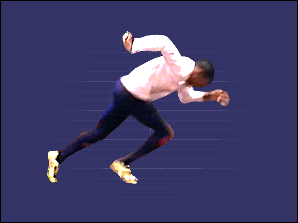 If you've been doing long, slow cardio, such as jogging, cycling, or swimming, for awhile without losing much weight or becoming much leaner even though you keep increasing your workouts, there is a simple explanation: too much cardio actually makes you fat. Excessive cardio increases stress hormones and down regulates the hormones, such as growth hormone and testosterone, that preserve muscle. In additon, elevated stress hormones make you insulin resistant, which leads to overeating as well as to eating foods that contribute to insulin resistance, such as sugars and starches.
Despite their appearance, many joggers and cyclists are not really lean. They may be slender because they have little muscle mass, but their body fat percentages are often surprisingly high.. In contrast, sprinters are lean and muscular with low body fat percentages. They have high human growth hormone (HGH) and testosterone levels--good for both females and males. Think back to the last track meet you saw. Who would you rather look like: the sprinters or the distance runners?
Benefits of Sprinting
1) Sprinting will reduce body fat and strengthen you far more than long, slow cardio because sprinting requires maximal recruitment of muscle. After about 8 seconds, sprinting sends acid signals to the muscles, which activates the fast twitch fibers. Fast-twitch fibers are thicker than slow twitch fibers, and it is fast twitch fibers that grow in size when activated by the right training.
2) Sprinting naturally increases human growth hormone. Human growth hormone increases muscle mass, thickens and adds flexibility to the skin, enhances the immune system, promotes weight loss through fat redistribution and loss, and increases stamina.
3) Sprinting strengthens your cardiovascular system with brief bursts of high intensity followed by long periods of recovery. You strengthen your skeletal muscles by doing heavy, low-repetition sets with long recoveries. You should strengthen your heart the same way. Sprinting doesn't cause the continuous stress on the heart that long, slow cardio does.
4) Sprint workouts are short and a lot more fun than long, boring cardio workouts.
The Definition of Sprinting
Based on the misleading articles and workouts I've seen posted all over the web, I'd better define what sprinting is. Sprinting is not just running faster than a jog. You cannot "sprint" for 30-60 second or even more with an equal recovery for 6-10 repetitions as some fitness "experts" advise. This is an anaerobic or interval workout. It's far better for you than plodding along the road or on a treadmill, but it's not sprinting and won't give you the benefits mentioned above. Sprint means "to race or move at full speed." Think playing tag or running to first base after a hit. Sprint workouts feature short, high-intensity repetitions and long, easy recoveries.
Where to Do a Sprint Workout
A track is the best place to do sprints because it's marked (in meters), and its surface is ideal for sprinting. A grass or dirt surface is next best; however, check your course for gopher holes and such before starting your sprints. Twisting an ankle will end your sprint workouts for awhile. The one place not to do your sprint workout is on concrete. Your back will thank you.
How to Do a Sprint Workout
Start your workout by warming up for about 5 minutes. Measure out a course from 50-100 yards (or meters) long. Remember that you need to sprint at least 8 seconds before your body sends the signals that produce human growth homone. Do 5-10 repetitions. The total distance of your sprints should not exceed 400-800 yards or meters. Between repetitions, walk slowly at least twice the distance that you ran. This should take from 1-2 minutes. Don't jog to "keep your heart rate up." You need to recover so that each repetition can be run at close to full speed. No matter what workout you planned, if you reach a point where you can't sprint because of fatigue, quit. Jogging to "finish" the workout won't do you any good since intensity is the objective, not volume.
If you're out of your teens and haven't been sprinting for a year or more, you will probably not be able to sprint at full speed right away. You should allow yourself at least a week for every decade you've lived to build up to full speed sprinting. In other words, if you're 40 and haven't been doing any sprinting in the past year, allow at least 4 weeks of gradually increasing the speed of your sprints before trying to go full speed in your workout. Even then, it doesn't hurt to hold back a little on the first repetition or two of each session.
How Often to Do a Sprint Workout
If you're running, cycling, swimming, etc. in addition to sprinting, limit your sprint workouts to twice a week with at least 48-72 hours between. If you're not doing anything else but strength training, you can go to 3 times a week if you want.
Sprinting is a natural and valuable human activity. If you think back to when you were a kid, how many times did you jog for miles? Almost never, right? On the other hand, you probably sprinted nearly every day on the playground, the athletic field, or just down the street. If you want to maintain a youthful body, you have to continue to do the things that youthful bodies naturally do. Sprinting is one of those things.
There is a common misconception that people are born with speed, but speed is like intelligence; it is invisible until developed. An amazing new book called Developing Killer Speed reveals how you can decrease your forty yard dash By .4 seconds in 2 weeks! To discover the simple formula that can increase your speed and decrease your times, click here.
Subscribe to:
Posts (Atom)